

Yuelamu
Yuelamu is a small community located in the Central Desert region of the Northern Territory. After experiencing years of limited to no Wi-Fi and mobile connectivity and relying on public telephones and a CfAT hotspot, a Telstra 4G mobile macro-cell tower was constructed near the community in 2023. The new mobile service has brought about much-needed improvements in connectivity and allowed residents to access services from their homes.

50km from Yuendumu

Anmatjerre
Digital Inclusion score
ADII scores range from 0 to 100. The higher the score, the greater the level of digital inclusion. ADII scores are relative: they allow comparisons across different social groups, different geographic areas, and over time. Yuelamu has a score of 45.2, with a gap of 28.0 when compared against national results, and is considered Excluded.
Dimension scores
We measure digital inclusion across the three dimensions of Access, Affordability and Digital Ability; identified as the key requirements of digital inclusion. Where early research on digital inclusion focuses on questions of access, subsequent work highlights affordability challenges, and shows the importance of digital skills or abilities as the use of online technologies has grown. To understand and address digital inclusion, it is important to pay attention to Access, Affordability and Digital Ability simultaneously.


Community Outcomes Reports
|
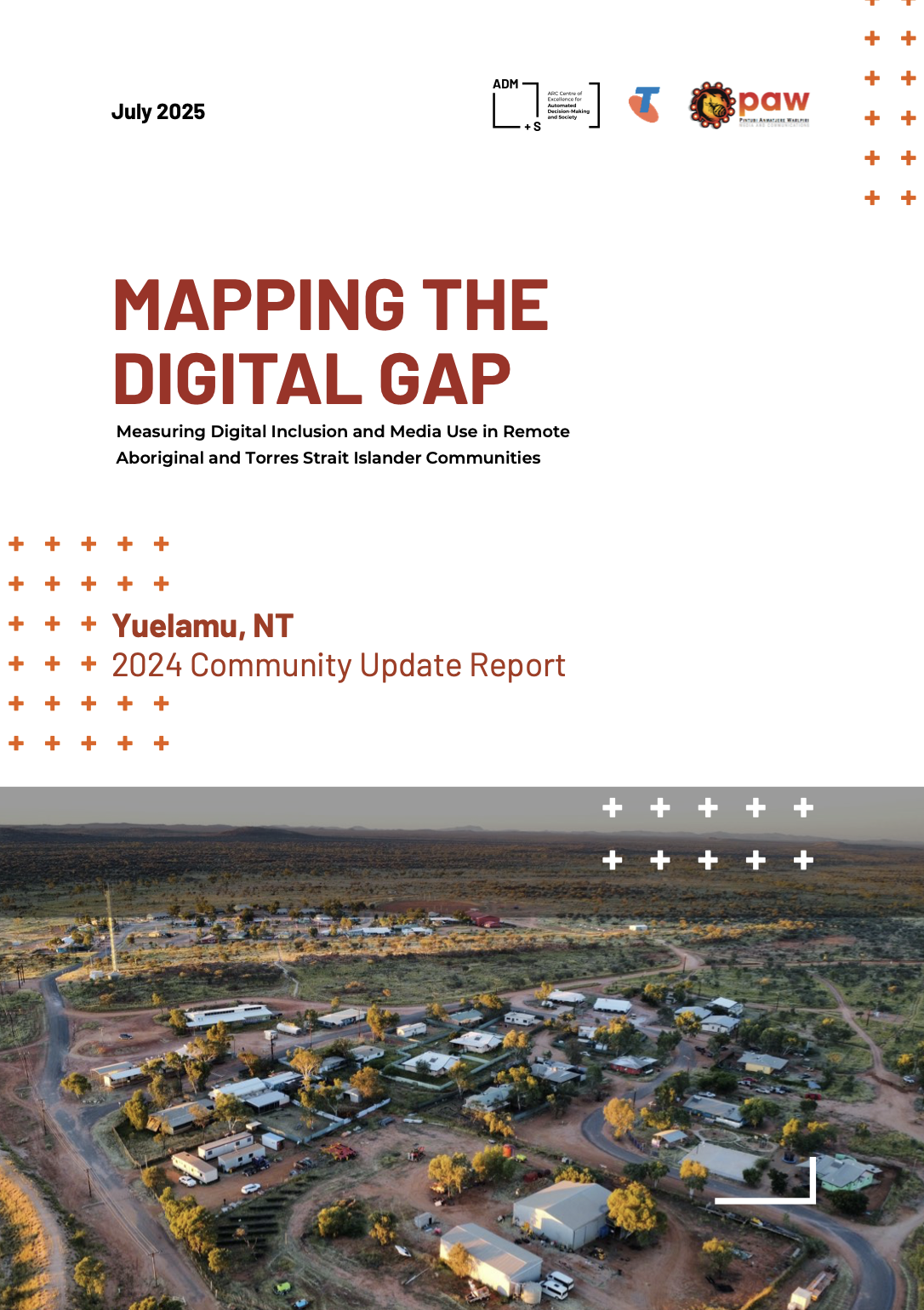
Yuelamu, NT community update report 202428 July 2025 Read PDF online |
Summary
This report outlines updated findings from the third research visit to Yuelamu, a small community located in the Central Desert region of the Northern Territory (NT). It outlines changes in First Nations digital inclusion over three years, updating the state and usage of communications and media services in Yuelamu from 2022 to 2024.
The report is intended to assist local agencies, leaders and residents to better understand the barriers to digital inclusion, develop local strategies to address these barriers, and support planning and partnerships with government and industry stakeholders.
|
Yuelamu, NT community update report 20233 May 2024 Read PDF online |
Summary
Our second research visit to Yuelamu was undertaken 15–20 May 2023. The team had a very productive week, undertaking 55 surveys with residents and conducting 8 interviews with agencies and community leaders. This report presents research findings to date, compares survey results from 2022 and 2023, outlining changes in communications and media services and usage, and renewing the analysis section with 2023 findings and quotes. The proposed Digital Inclusion Plan has been updated based on community input and progress to date, as well as planned activities.
|
Yuelamu, NT community update report 20226 Dec 2022 Read PDF online |
Summary
Based on 37 surveys and 12 stakeholder interviews, this report outlines the initial findings from the 2022 visit, and highlights the current access and use of media, telecommunications and online services, as well as the digital inclusion and service delivery challenges in Yuelamu and across the Central Desert region. This report is intended to assist local and regional agencies, including PAW Media, Central Land Council Central Desert Regional Council, as well as Northern Territory Government, to better understand the key barriers to digital inclusion in Yuelamu and the region and community aspirations for the future.
population (ABS 2021)
Aboriginal and/or Torres Strait Islanders (ABS 2021)
occupied dwellings; 4.8 people per ATSI household (ABS 2021)
Research Partner
Pintubi Anmatjere Warlpiri Media and Communications (PAW Media)


Local Research Team
Community co-researchers are employed in each community to support research activities and contribute research findings between site visits. These roles provide local jobs and support capacity building.
Community co-researchers play a central role in the research, liaising between the research team and the local community, providing cultural guidance to the research team, acting as translators, facilitating research activities, identifying possible participants and communicating information to community members.
We’d like to extend our gratitude to the support of our Yuelamu co-researchers and research partners:
Stephanie Lynch
Co-Researcher
Dennis Charles
Co-Researcher
Mel Langdon
Co-Researcher


Photos from research activities


Mapping the Digital Gap
Mapping the Digital Gap is the first extensive study of digital inclusion and use of media and communications services in remote First Nations communities across Australia. Using qualitative and quantitative research methods, the project is providing data to help measure progress on Closing the Gap Target 17, which aims for equivalent levels of digital inclusion for First Nations people by 2026.
Mapping the Digital Gap is a partnership project between the ARC Centre of Excellence for Automated Decision-Making and Society (ADM+S) and funding partner Telstra, as part of the Australian Digital Inclusion Index research suite. The research team also partner with local First Nations organisations and co-researchers to undertake on-site research annually in participating communities.