

Wilcannia
Wilcannia is a small town located within the Central Darling Shire in north western New South Wales, Australia. Access to and affordability of communications services are key barriers to digital inclusion in Wilcannia; most residents are reliant on pre-paid mobile for voice and data on a congested and unreliable connection.

456km from Broken Hill

Baarkandji river people
2025 Digital Inclusion score
ADII scores range from 0 to 100. The higher the score, the greater the level of digital inclusion. ADII scores are relative: they allow comparisons across different social groups, different geographic areas, and over time.
2025 Dimension scores
We measure digital inclusion across the three dimensions of Access, Affordability and Digital Ability; identified as the key requirements of digital inclusion. Where early research on digital inclusion focuses on questions of access, subsequent work highlights affordability challenges, and shows the importance of digital skills or abilities as the use of online technologies has grown. To understand and address digital inclusion, it is important to pay attention to Access, Affordability and Digital Ability simultaneously.


Community Outcomes Reports
|
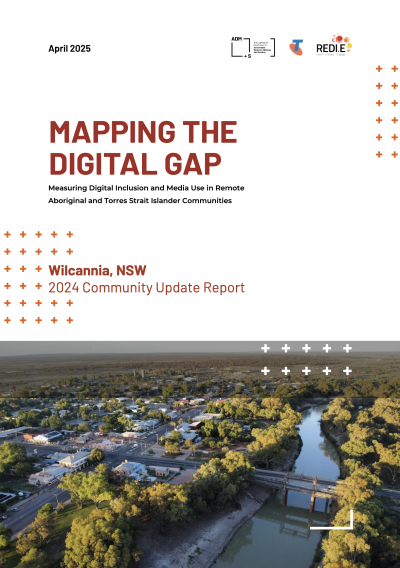
Wilcannia, NSW 2024 community update report24 Apr 2025 Read PDF online |
Summary
This report outlines updated findings on digital inclusion in Wilcannia, western New South Wales. It aims to assist community agencies, leaders and residents to better understand the barriers to digital inclusion, develop local strategies to address these barriers, and support planning and partnerships with government and industry.
Key findings
- Mobile phone access has declined since the 2022 survey, down from 93% to 84%.
- 81% of the population had no form of fixed home internet, down from 92% in 2022.
- Internet affordability was worse since the 2023 survey, with 51% compromising on internet speed or quality due to affordability and 40% cutting back on essential household costs to afford internet access.
- A majority of people were regularly using digital services such as online banking (85%), social media (88%) and online government services (83%).

|
Wilcannia, NSW 2023 community update report23 Nov 2023 Read PDF online |
Summary
This report outlines updated findings from a second research visit to Wilcannia, situated on the banks of Baarka (Darling River) in western New South Wales. This report presents combined research findings to date, comparing 2023 survey results with 2022 results, outlining any changes in communications and media services and usage, and adding new findings and quotes from interviews to the analysis section. The proposed Digital Inclusion Plan has been updated based on community input and any progress to date, including current or planned activities.

|
Wilcannia, NSW community outcomes report23 June 2022 Read PDF online |
Summary
population (ABS 2021)
Aboriginal and Torres Strait Islanders (ABS 2021)
occupied dwellings; 3.3 people per ATSI household (ABS 2021)
Research Partner
Regional Enterprise Development Institute
Regional Enterprise Development Institute (REDI.E) is a non-profit organisation that that supports its local communities by opening doors to opportunity, positive career pathways and economic development. They create partnerships that will bring more industry to their regions, ensuring their long term sustainability. They are an Indigenous owned and managed organisation, proud to deliver employment, training and community services within the Murdi Paaki region and other parts of NSW.


Local Research Team
Community co-researchers are employed in each community to support research activities and contribute research findings between site visits. These roles provide local jobs and support capacity building.
Community co-researchers play a central role in the research, liaising between the research team and the local community, providing cultural guidance to the research team, acting as translators, facilitating research activities, identifying possible participants and communicating information to community members.
We’d like to extend our gratitude to the support of our Wilcannia co-researchers and research partners:
Shaylin Wiltshire
Co-Researcher
Anthony Wiltshire
Co-Researcher
Monica Kerwin
Co-Researcher
Bobbi Harris
Co-Researcher
Katelyn Whyman
Co-Researcher
Sheldon Hunter
Co-Researcher
Shalarna Thorpe
Co-Researcher
Brendon Adams
2022 REDI.E Site Manager
Robert Clayton
2023 REDI.E Acting Site Manager
Darrin Atkinson
2024 REDI.E Site Manager


Media
Photos from research activities


Mapping the Digital Gap
Mapping the Digital Gap is the first extensive study of digital inclusion and use of media and communications services in remote First Nations communities across Australia. Using qualitative and quantitative research methods, the project is providing data to help measure progress on Closing the Gap Target 17, which aims for equivalent levels of digital inclusion for First Nations people by 2026.
Mapping the Digital Gap is a partnership project between the ARC Centre of Excellence for Automated Decision-Making and Society (ADM+S) and funding partner Telstra, as part of the Australian Digital Inclusion Index research suite. The research team also partner with local First Nations organisations and co-researchers to undertake on-site research annually in participating communities.