

Gäṉgaṉ homeland
Gäṉgaṉ homeland is one of 30 community-managed Layhapuy homelands in the East Arnhem region. There is no mobile coverage and no fixed internet in the 13 households. Primary communications is via the public phone and a free Wi-Fi hotspot at the local store available from 2–8pm daily, using nbn Sky Muster.

206km from Nhulunbuy

Yolŋu and Dhuwala people
2025 Digital Inclusion score
ADII scores range from 0 to 100. The higher the score, the greater the level of digital inclusion. ADII scores are relative: they allow comparisons across different social groups, different geographic areas, and over time.
2025 Dimension scores
We measure digital inclusion across the three dimensions of Access, Affordability and Digital Ability; identified as the key requirements of digital inclusion. Where early research on digital inclusion focuses on questions of access, subsequent work highlights affordability challenges, and shows the importance of digital skills or abilities as the use of online technologies has grown. To understand and address digital inclusion, it is important to pay attention to Access, Affordability and Digital Ability simultaneously.


Community Outcomes Reports
|
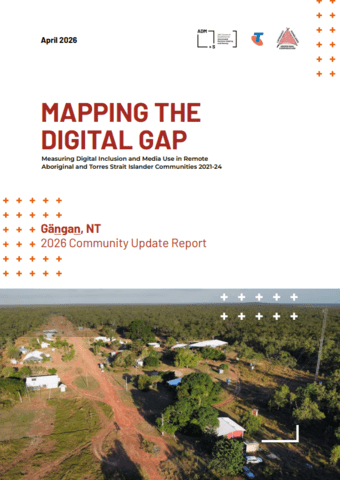
Gäṉgaṉ, NT 2026 community update report21 Apr 2026 Read PDF online |
Summary
This report outlines updated findings based on a third and final research visit to Gäṉgaṉ in 2024 as well as updates since a 2024 visit. Building on the Gäṉgaṉ NT 2023 community update report, this update report is intended to assist local and regional agencies, leaders and residents to better understand the barriers to digital inclusion, develop local strategies to address these barriers, and support planning and partnerships with government and industry stakeholders.
Key findings
- When finalising the last visit to Gäṉgaṉ in 2024, the primary means of residential connectivity was the public phone and public Wi-Fi at the shop, with no mobile phone coverage or household broadband.
- Since its introduction in October 2024, the National Broadband Network community-wide Wi-Fi network has seen strong uptake. Its community-controlled model supports curfews and content filtering; however, residents have requested additional management support and raised concerns regarding its outdoor-only access.
- A case study on the Laynhapuy Homelands School highlights ongoing connectivity challenges in the school network, which continue to limit access to admin tasks, online teaching resources and NAPLAN testing. Homelands teachers have reporting relying on pen and paper and personal mobile data, with calls for upgrade to schools across the region.
|
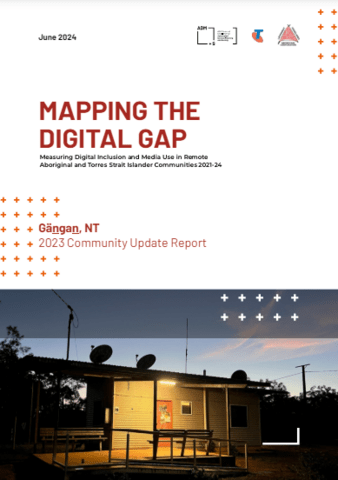
Gangan, NT community update report14 Jun 2024 Read PDF online |
Summary
This report outlines updated findings from a second research visit to Gangan Homeland. The report is intended to assist local and regional agencies, leaders and residents to better understand the barriers to digital inclusion, develop local strategies to address these barriers, and support planning and partnerships with government and industry stakeholders. This report presents research findings to date, compares survey results from 2022 and 2023, outlines changes in communications and media services and usage, and renews the analysis section with 2023 findings and quotes.

|
Gangan, NT community outcomes report22 Mar 2023 Read PDF online |
Summary
The first research visit to Gängan was undertaken from 23rd to 27th May 2022. Researchers conducted additional stakeholder interviews in Yirrkala on the 27th May. Based on 31 surveys and eight stakeholder interviews and discussions, this report outlines findings from the 2022 visit on access and use of media and communications, as well as the digital inclusion and service delivery challenges in Gängan and across the Laynhapuy homelands. This report is intended to assist local and regional agencies, including LHAC, East Arnhem Regional Council, Northern Land Council, as well as the Northern Territory Government (NTG), to better understand the key barriers to digital inclusion in Gängan and the region and community aspirations for the future.
population (ABS 2021)
Aboriginal and/or Torres Strait Islanders (ABS 2021)
occupied dwellings; 7.8 people per ATSI household (ABS 2021)
Research Partner
Laynhapuy Homelands Aboriginal Corporation


Local Research Team
Community co-researchers are employed in each community to support research activities and contribute research findings between site visits. These roles provide local jobs and support capacity building.
Community co-researchers play a central role in the research, liaising between the research team and the local community, providing cultural guidance to the research team, acting as translators, facilitating research activities, identifying possible participants and communicating information to community members.
We’d like to extend our gratitude to the support of our Gäṉgaṉ homeland co-researchers and research partners:
Djamika Ganambarr
Co-Researcher
Billy Gumana
Co-Researcher
Guruwuy Ganambarr
Co-Researcher
Marrpalawuy Marika
Co-Researcher
Kerry Legge
CEO, Laynhapuy Homelands Aboriginal Corporation

Photos from research activities


Mapping the Digital Gap
Mapping the Digital Gap is the first extensive study of digital inclusion and use of media and communications services in remote First Nations communities across Australia. Using qualitative and quantitative research methods, the project is providing data to help measure progress on Closing the Gap Target 17, which aims for equivalent levels of digital inclusion for First Nations people by 2026.
Mapping the Digital Gap is a partnership project between the ARC Centre of Excellence for Automated Decision-Making and Society (ADM+S) and funding partner Telstra, as part of the Australian Digital Inclusion Index research suite. The research team also partner with local First Nations organisations and co-researchers to undertake on-site research annually in the 11 participating communities.