

Erub
Erub (Darnley Island) is located in the eastern island group of Zenadth Kes (Torres Strait), near the Great Barrier Reef. As an outer Torres Strait island, Erub faces unique communications challenges, with 4G mobile and ADSL services delivered via a regional microwave repeater network from Cape York.

196km to Horn Island

Erub Mer people
2025 Digital Inclusion score
ADII scores range from 0 to 100. The higher the score, the greater the level of digital inclusion. ADII scores are relative: they allow comparisons across different social groups, different geographic areas, and over time.
2025 Dimension scores
We measure digital inclusion across the three dimensions of Access, Affordability and Digital Ability; identified as the key requirements of digital inclusion.
Where early research on digital inclusion focuses on questions of access, subsequent work highlights affordability challenges, and shows the importance of digital skills or abilities as the use of online technologies has grown.
To understand and address digital inclusion, it is important to pay attention to Access, Affordability and Digital Ability simultaneously.


Community Outcomes Reports
|
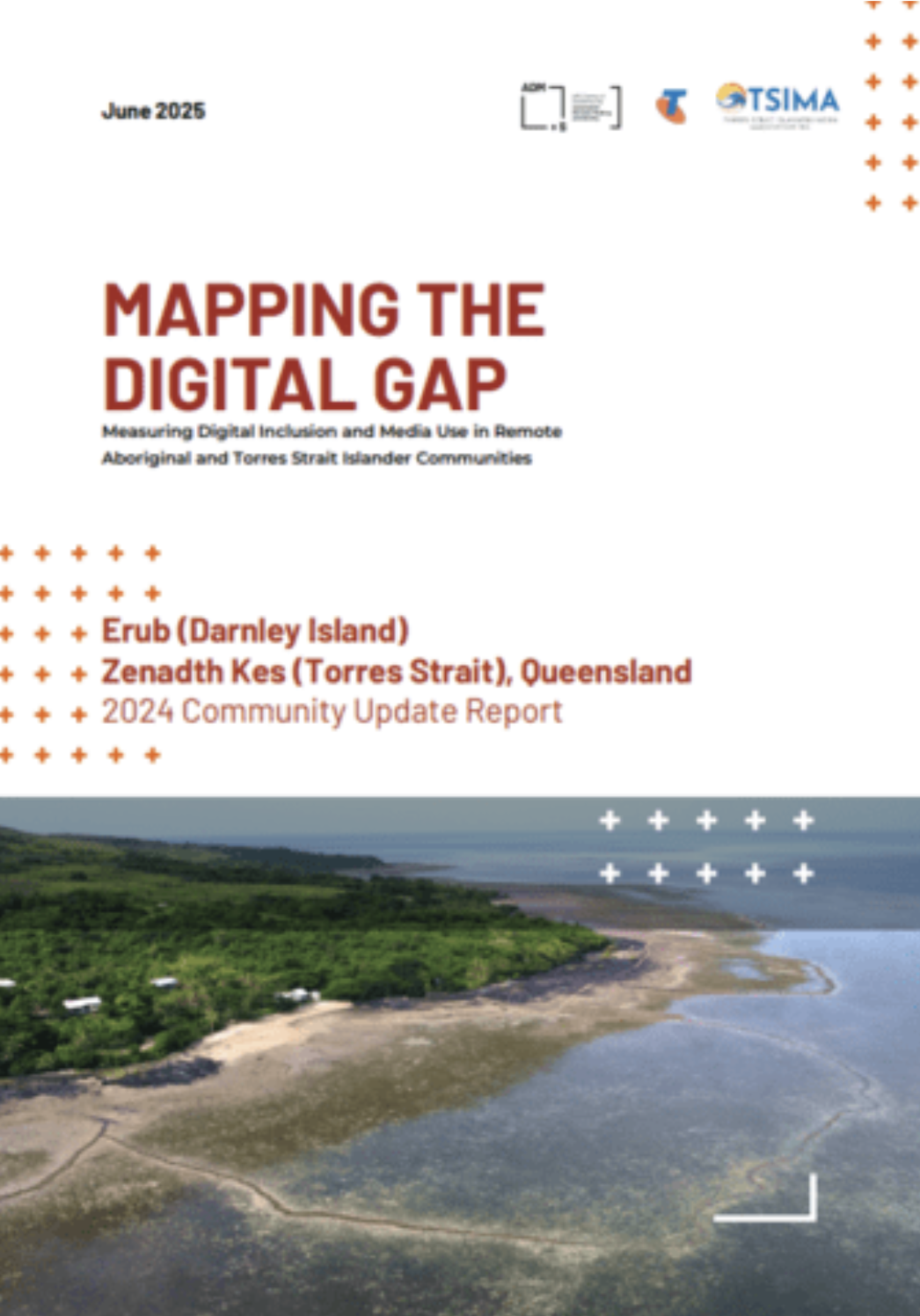
Erub (Darnley Island), Zenadth Kes (Torres Strait) 2024 community update report13 Jun 2025 Read PDF online |
Summary
This report outlines updated findings from the third research visit to Erub (Darnley Island), which is located in the eastern island group of Zenadth Kes (Torres Strait), near the Great Barrier Reef. It outlines changes in First Nations digital inclusion over three years, updating the state and usage of communications and media services on Erub from 2022 to 2024.
The report is intended to assist local Erub agencies, leaders and residents to better understand the barriers to digital inclusion, develop local strategies to address these barriers, and support planning and partnerships with government and industry stakeholders.
Key findings
- Frustrated residents reported little change in the patchy and unreliable mobile service.
- There is recent uptake of Starlink which is more reliable, but remains too costly for most households.
- Digital skills are high among young people, but older and disabled residents need more support.

|
Erub (Darnley Island), Zenadth Kes (Torres Strait) community update report9 Feb 2024 Read PDF online |
Summary
Building on the 2022 Erub community outcomes report, this update report is intended to assist community agencies, leaders and residents to better understand the barriers to digital inclusion, develop local strategies to address these barriers, and support planning and partnerships with government and industry stakeholders. The first research visit in April 2022 identified a range of challenges for Erub residents and service providers in terms of mobile and communications access, particularly outside of the central villages. Nevertheless, the researchers found high levels of digital ability compared with other Australians.

|
Erub (Darnley Island), Zenadth Kes (Torres Strait) community outcomes report4 Nov 2022 Read PDF online |
Summary
Based on 44 surveys and 14 interviews with residents and stakeholders, this report outlines the findings from our initial visit and highlights the current dynamics underpinning access and use of media, communications and online services and the digital inclusion challenges that Erub confronts. This report is intended to assist TSIMA, TSIRC and community agencies to better understand the key barriers to digital inclusion in Erub, assist in identifying communications infrastructure and program needs, and support planning and advocacy with government and industry stakeholders.
population (ABS 2021)
Aboriginal and Torres Strait Islanders (ABS 2021)
occupied dwellings; 3.5 people per ATSI household (ABS 2021)
Research Partner
Torres Strait Islander Media Association


Local Research Team
Community co-researchers are employed in each community to support research activities and contribute research findings between site visits. These roles provide local jobs and support capacity building.
Community co-researchers play a central role in the research, liaising between the research team and the local community, providing cultural guidance to the research team, acting as translators, facilitating research activities, identifying possible participants and communicating information to community members.
We’d like to extend our gratitude to the support of our Erub co-researchers and research partners:
Nixon Mye
Co-Researcher
Lala Gutchen
Co-Researcher
Diat Alferink
CEO, TSIMA
Jen Enosa
Senior Content Producer, TSIMA
Gilmore Johnston
Broadcaster, TSIMA

Photos from research activities


Mapping the Digital Gap
Mapping the Digital Gap is the first extensive study of digital inclusion and use of media and communications services in remote First Nations communities across Australia. Using qualitative and quantitative research methods, the project is providing data to help measure progress on Closing the Gap Target 17, which aims for equivalent levels of digital inclusion for First Nations people by 2026.
Mapping the Digital Gap is a partnership project between the ARC Centre of Excellence for Automated Decision-Making and Society (ADM+S) and funding partner Telstra, as part of the Australian Digital Inclusion Index research suite. The research team also partner with local First Nations organisations and co-researchers to undertake on-site research annually in participating communities.